Friday, July 8, 2011

JUNK: The Neglected Moderns

There are so many neglected and disrespected moderns out there.  My purpose here is not to be encyclopedic; just to make a swipe.  Every city has a lot of mid-century modern buildings being pulled down these days.  A substantial fraction of the population feels the style is more or less disposable.

One idea is to document -- or mention -- a few buildings that could be torn down at any time, should the owners choose to.  In terms of materials, these buildings may be disposable or replaceable.  But what are the chances we will bother to replace them?


So in no particular order, here are some un-noteworthy modernist buildings c. 1960-72 that don't fit into any clear theme.


Here's a Catholic Charities building in St. Paul, MN.  No architect known for it.  Obviously early 60s.


Here is a very exciting little motel in Miami (moderne, yes?)  I have no information about it.


These hooks are at Boston Logan.  Not very compelling architecture?  You should see my picture of the urinals.  


The Rohm & Hass Headquarters in Philadelphia (completed 1964).  Architect Pietro Belluschi.  Since I was there, it was (in 2007) declared a member of the National Historic Register thanks to its important place in the history of modernism.


Shown below, the Tokyo skyline has some utilitarian elements that nobody would preserve intentionally.  But they add up to something fantastic:


Here's a modest park structure at Great Falls, VA.  To be retained or replaced?


Below: the Washington DC Metro has interiors designed by Harry Weese.  The vaulted ceilings were voted #106 on America's Favorite Architecture list by AIA.


Abandoned race facility east of Phoenix, AZ.


This is right near the Trotter Park in Arizona.


Here's the amazing Buckner Building in Whittier, Alaska.  273,660 square feet of abandoned government property, circa WWII.  You can see a certain determined efficiency (brutalist elements?) here.


The Cobo Center (originally Cobo Hall) in Detroit was opened in 1960.  The architect was Gino Rossetti.  


Now, more Minneapolis pictures!!  


 Here's a Minoru Yamasaki creation called the Northwestern Mutual Financial Network (NMFN) headquarters (1964), which is now the North American HQ of ING.  This was Yamasaki's design immediately before doing New York's World Trade Center twin towers.  It makes use of at least 2 water features, not unlike the Rohm + Haas building.


Can we say there is some Miro sculpture influence?  Just a thought.  Here's a 1963 Miro sculpture in Chicago, at Brunswick Building Plaza.

Meanwhile, at Rohm & Haas:

What can we say???  I can pretend these weren't the same year, but obviously some very crazy public works projeccts were being done in 1962-64.  Urban renewal was in full effect.  This was a strange time.


Another Yamasaki view:

ING appears to be keeping the building in A-1 shape. 


Minneapolis Federal Reserve (1973) building.  Obviously the face of the building is expressing the load-bearing suspension design of the building's chassis.


Dramatic photography is the way to come to terms with these buildings.  I have stolen these photos for this blog and the rightful owners have every right to be angry and yet glad. 


From Downtown East on University Ave, you might come across this building:

The University Park Plaza building (below, 1971); pentagonal late International style office stack.  It is worth some detail shots I will add later.


Further down University Avenue to Saint Paul, you can find some unsung modernist buildings in St Paul Campus.


 Above, some lights at one of the un-rennovated parts inside St. Paul Student Center (1960).  The Northstar Ballroom is still early 1960s vintage top to bottom.


What is now Ruttan Hall (Griswold and Rauma, 1972) is a shit building basically, but a group of Design School students were trooped through this hallway, described by their interlocutor as "mental institution" style.  I guess this style sometimes is designed to break you of all humanity.  (exterior below)


Early 80s tailings of this period?  I would wager yes.  California had some.    Here's a house we rented in San Diego from about 1983.  You can pretty much peg the year by looking at it:


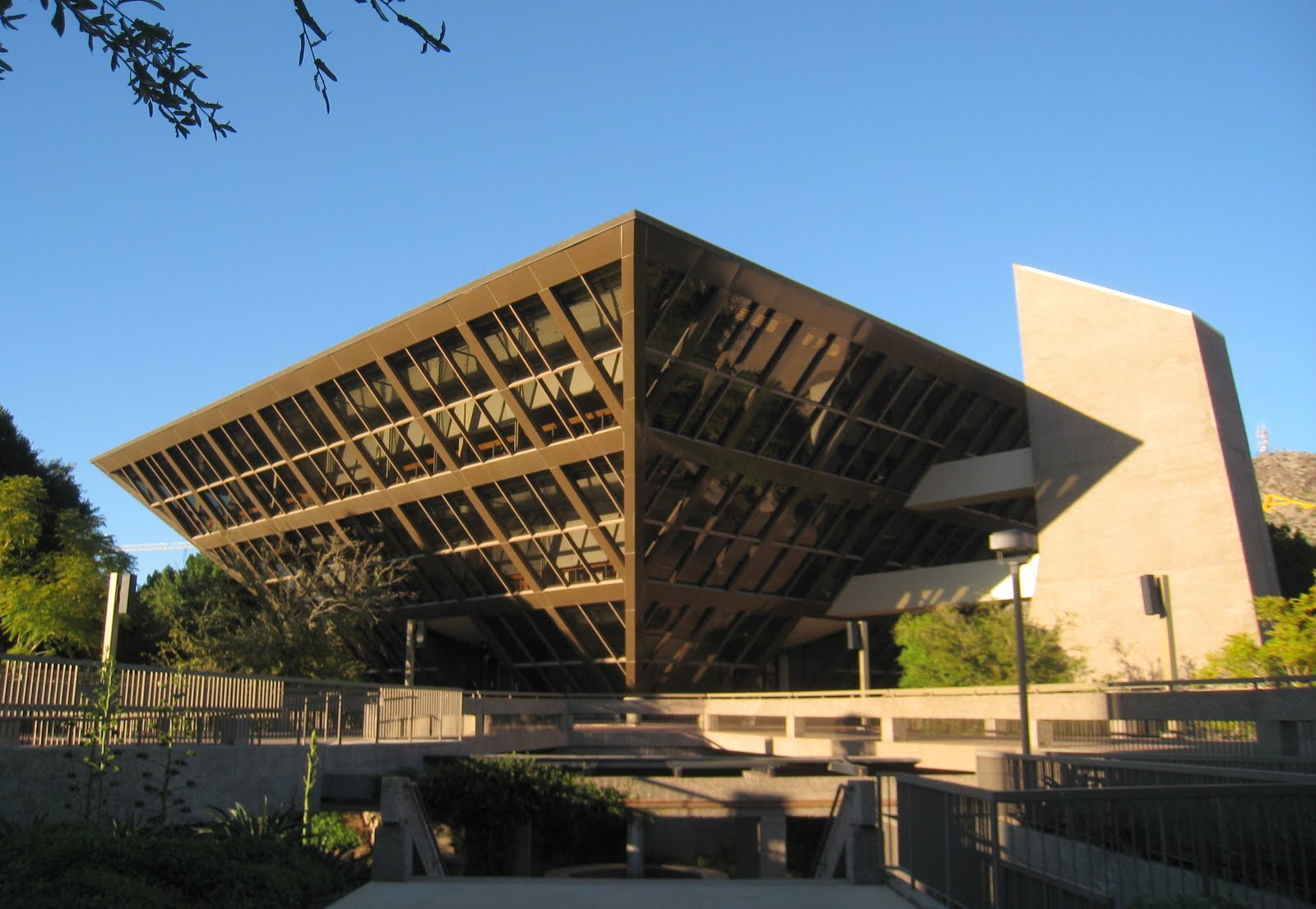
Kind of reminds you of the inomparable Tempe City Hall (1971) - Tempe, Arizona.  The city council wanted to express a "we are leaving this motherfuking universe" sentiment popular at that time.


A final building nobody really appreciates up front is , the Hopkins Center (opened 1962) at Dartmouth.  Not always respected as "antique," it is just good enough to warrant (and receive?) preservation. 

It was designed by Wallace K. Harrison and (according to the wiki) foreshadows his later Lincoln Center, NYC design.  I hope you enjoy my photo taken on a happy day for me (read the marquee).


Tuesday, June 28, 2011

Modernist Cars?

Is it true that modernism bled into car building?
Yes, the cars and buildings of this era were meant to work together.
Probably one of the best examples of this is the Detomaso Mangusta:


If you want lots of details about Italian automakers of the 1960s, there are many books about Bertone, Pininfarina, Italdesign etc.

But American cars were also at the forefront in the 1960s, wherein architectural style and car design were going in lockstep toward a mid-60s angular ideal.  Consider the 1965 Ford Thunderbird:


The '65 Ford definitely seems to have some Italian influence, that is to say, strict modernist.  The vent at the base of the rear window is really stunning.  I just saw one of these on the road this weekend.

Wild statement cars from Bertone kind of explored the logical terminus of the pure modernism.  The Stratos Zero:


The bizarro world of Bertone (Marcello Gandini) created the above Lancia Stratos Zero (1970) and some other pretty fantasto-ridiculous pointy Italian things.  Such as the "Lamborghini" Marzal (1967)!!


The dash motif insider this car (hexagonal "honeycomb" grids) is an element you may recognize from buildings of the period.  Here's a Marcel Breuer example from the Saint John's Abbey in Collegeville, MN


The mid-1960s had it going on!

The Giorgetto Giugiaro-designed Lotus Esprit prototype (1972) was supposedly a "folded paper" design.  Obviously, the original here was probably a little more classy than the later Lotus Esprits that were built in the 1980s-90s.

From the same Paris 1972 car show, Italdesign's other show car, the Maserati Boomerang, also needs a look:


Let's also give some due credit to the Americans:

 (Above) about 1964 Buick Riviera.

(Below) 1960 Ford F-100.

(Below) Even the wipers on a Chevelle had a nice tanky metal over-builtness that was part of American -- relative to Italian -- 1960s modern design.


1950s Italian.

Thursday, June 23, 2011

Higher Ed

Universities and Colleges (and secondary schools) have sponsored some interesting modern buildings.

For example MIT had Eero Saarinen build two.

Kresge Auditorium (1953-55):


Kresge Chapel at MIT:


To mention an obvious tangent for future posts, modernism found some very great exponents in church builders during the 1940s-70s.  Minneapolis / St. Paul has loads of them.

The Beinecke Library (Gordon Bunshaft, 1963) at Yale has a neat CRT television-style stencil across the exterior.


Those CRT patterns also appear in the 1971 University Park Plaza, a pentagonal (!) office building adjacent to the Twin Cities campus of the University of Minnesota.


Dear old Dartmouth had a few nice modernist designs, which of course were destroyed.  The Peter Kiewit Computation Center:


....  as well as Gerry and Bradley Halls, the famous "Shower Towers."  Kiewit was destroyed in 2000.  It was interesting partly because its main public accommodations were one level under grade.  

The Shower Towers:


Now gone.

St. John's University in Collegeville, MN has several amazing modernist assets (including their incredible Marcel Breuer designed Abbey, to be included in a churches post -- perhaps an exclusive Catholic Church post).

Their Peter Engel Science Center, of Marcel Breuer:


And their Alcuin Library:


What an amazing place.  I think St. John's might have the top modernist assets and certainly wins for concentration of modernist sites.

Kosovo's National Library in Pristina deserves a look:


Whew!  That's crazy!

Finally, something pretty well chronicled in architecture books: Louis Kahn's creation at Phillips Exeter Academy in Exeter, NH.  Kahn designed this library in 1965.